
January 2026 at HAPP: From AI Assistant to Managed Infra
HAPP AI Team
Product
· 8 min read
In most companies, AI is still seen as a tool. An extra layer of automation. A response channel. A bot that works instead of an operator.
But in real business in 2026, AI already plays a different role. It doesn't just answer customers — it works with CRM, creates deals, updates data, runs scenarios. It becomes part of the operational infrastructure.
That's what we built the January HAPP platform updates around.
The goal wasn't to add "new features". The goal was to make AI more controllable, more integrated, and more stable in production.
More control over assistant behaviour
One of the main problems with AI in business is universality. The assistant sounds "fine", but doesn't match the style of a specific company. It works logically, but not the way the operations team expects.
In January we added advanced behaviour settings for the assistant. You can now control tone, scenario logic, and request-handling priorities more precisely.
That means the assistant in a clinic, e‑commerce, or B2B company can behave differently — not only in wording but in the micro-decisions it makes in the dialogue.
AI becomes not a "generic voice" but part of a specific business model.
Asynchrony as the norm, not the exception
In live conversation, a pause is a loss of trust. Especially when the assistant is checking order status or fetching data from CRM.
We added asynchronous tools. Long-running operations now run in the background without freezing the dialogue. The assistant keeps the conversation going, clarifies details, or maintains contact while the system fetches data.
For the customer it feels like a live conversation. For the business — stable handling of complex requests without a speed drop.
This matters when AI isn't a demo but the first line of interaction.
Long operations run in the background — the assistant keeps talking while the system fetches data. For the customer it's a live conversation; for the business, stable handling without speed drops.
More complex automation scenarios
We also extended the types of parameters that can be passed into tools. Technically that means support for more complex data structures. From a business perspective — the ability to build deeper scenarios.
The assistant can pass not just text but structured objects, nested parameters, multi-level data. That enables complex automation: from flexible work with deals to multi-step handling of requests.
AI stops being a "message filter" and becomes a full participant in the operational process.
System tokens: stability instead of dependence on people
Many integrations in companies are tied to specific employees. When someone leaves, automation breaks.
We added system access tokens that are not tied to a user. Integrations keep working regardless of staff changes.
It's a technical detail, but it solves a real business problem — stability of automated processes in the long term.
Ecosystem expansion: Messenger and 4 CRMs
January was also the month we scaled integrations.
The assistant now works in Facebook Messenger — without operators, 24/7. That means requests from social networks are no longer lost or left waiting until morning.
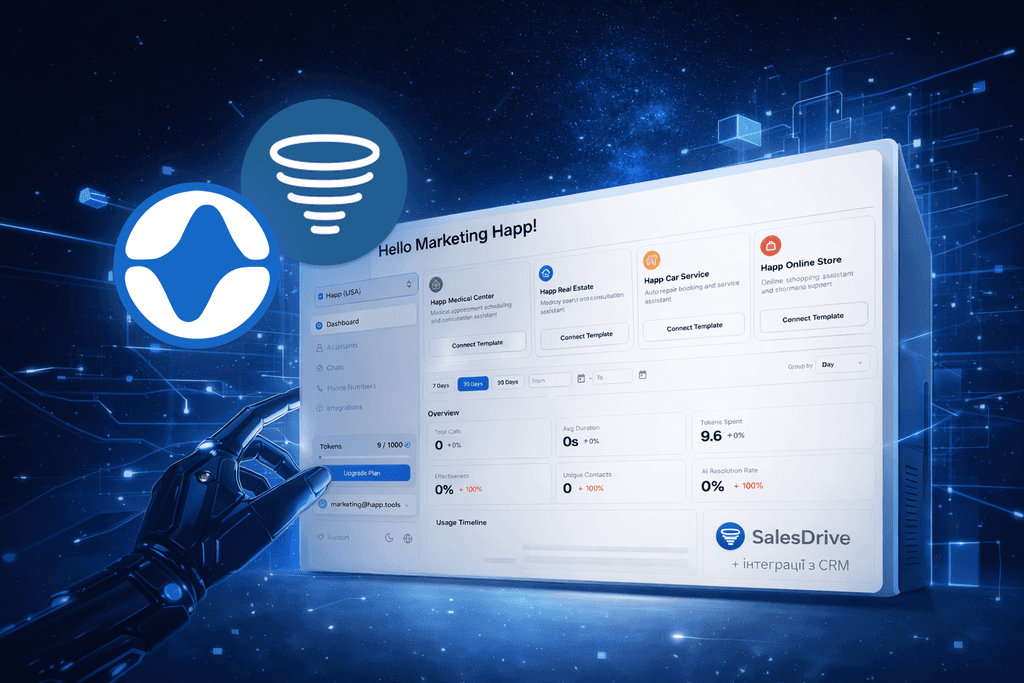
We added integrations with NetHunt CRM, Odoo, KeyCRM, and SalesDrive. During a dialogue the assistant can search for the customer, create leads, form deals, and update records.
In practice it means one thing: the conversation becomes data immediately. Data becomes process immediately.
No manual copying, no duplication, no loss of interaction history.
In January: Messenger integration and four new CRMs. Conversation becomes data, data becomes process, with no manual copying or lost history.
Fitting into your infrastructure
Thanks to webhooks for calls, data can now be sent to any internal system — analytics, billing, ERP, or custom solutions.
HAPP is no longer a separate tool. It becomes part of the company's overall architecture — including via our voice agent and integrations with your systems.
Performance and stability
We optimised access token checks, which noticeably sped up the platform under load. In parallel we fixed issues with media files, chat history, dialogue loading, and message duplication.
These changes aren't always obvious at first glance, but they determine whether the system is ready to scale.
Summary
In January 2026 HAPP gained:
- Facebook Messenger integration
- four new CRMs
- seven AI capability improvements
- five key stability fixes
But the main point is that the platform became more controllable, more flexible, and more integrated.
AI in business is not a separate feature. It's an infrastructure layer. And that's exactly what we're steadily moving HAPP toward.
Need a consultation?
We’ll show how HAPP fits your business.