
AI in 2027: Infrastructure, Not Intelligence
HAPP AI Team
Customer Success
· 10 min read
Why talk about AI “smartness” no longer makes sense
Over the past few years, business has grown used to talking about AI in terms of impressions: how “smart” the model is, how naturally it answers, how good the demo looks. That approach made sense when AI was still a new tech toy — something interesting to watch.
It stops working the moment AI becomes part of a company’s operational reality.
By 2027, organisations that still judge AI through the lens of “intelligence” will run into a systemic problem: the technology is already ready to operate at scale, but the way we think about it is not. The winners are not those with the “smartest” model, but those who correctly understand its role in the business.
AI stops being an intelligence to marvel at. It becomes infrastructure to rely on.
Why this isn’t a new story for business
This shift is not unique to AI. Business has been through similar transformations before.
Once, companies argued about database capabilities, query languages, and technical optimisations. Over time, those conversations lost relevance. The only criterion that remained was reliability: does the system handle load, is it stable under pressure, does it recover after failures?
The same happened with cloud. Today nobody chooses cloud infrastructure for “intelligence”. It’s evaluated on economics, scalability, SLAs, and behaviour in crisis.
AI is entering the same phase. The only difference is that the pace of change is much higher.
Where the old mental model breaks
Problems don’t show up during experiments, but when AI starts affecting real processes: order handling, customer interaction, financial decisions, compliance.
While AI exists as pilots or support tools, you can live with inaccuracies, instability, or manual intervention. When the system becomes part of the production chain, the criteria change.
Business starts asking different questions: does the system behave predictably; are errors visible before they affect customers; can we measure impact and improve it over time?
This is where many AI initiatives get stuck. Not because of weak models, but because of missing architecture. AI is deployed in environments that aren’t ready for autonomous decisions. The errors aren’t catastrophic, but they are systemic. Trust erodes, scaling stops.
The key shift: from answers to execution
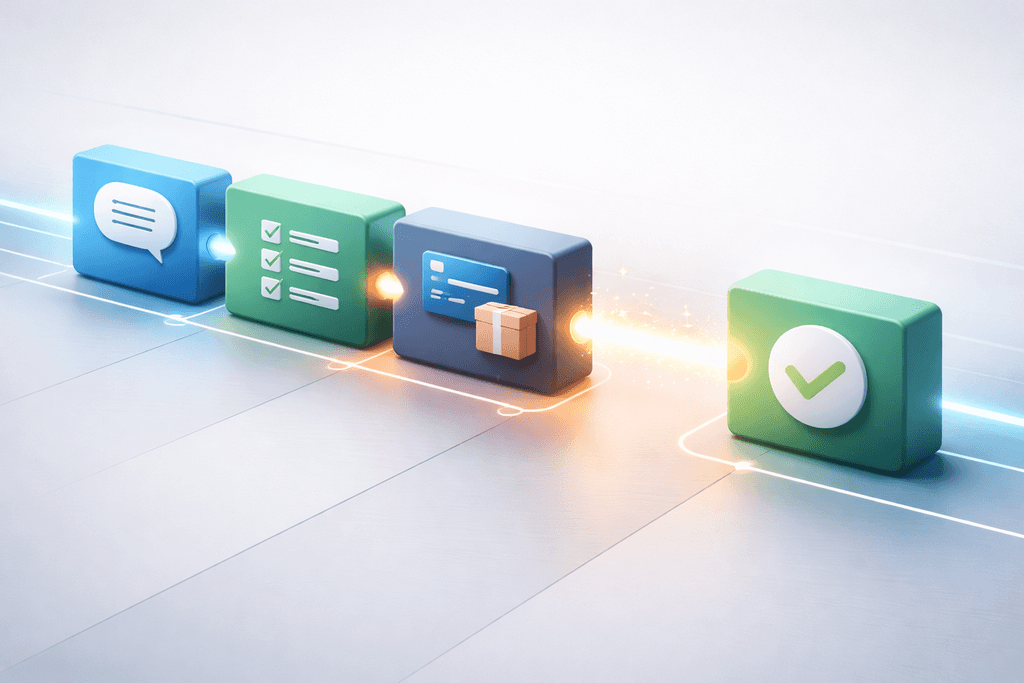
The most important change we’ll see by 2027 is AI moving from generating answers to executing actions.
When AI confirms orders, routes enquiries, triggers processes in other systems, or makes decisions in real time — errors stop being local. They propagate across the whole chain.
At that point “intelligence” becomes secondary. What becomes critical is control, observability, and manageability. That’s why business is moving from the language of “assistants” to the language of agents, orchestration, and the execution layer. These aren’t buzzwords — they describe the new operational reality.
When AI confirms orders, routes enquiries, or triggers processes, errors propagate across the whole chain. Then control and observability become critical, not model 'smartness'.
What infrastructure-level AI means
At the enterprise level, AI must behave like proper infrastructure. That means the system must:
- run stably under variable load
- be deeply integrated into the existing IT stack
- have transparent logging and metrics
- have controlled failure scenarios
- improve outcomes based on data, not assumptions
Everything else may look impressive but doesn’t hold up in real use.
Who will actually scale AI by 2027
Strategically, companies will gradually split into three types.
| Type | Description |
|---|---|
| AI as infrastructure | They redesign processes, define accountability, measure results. AI “dissolves” into operations. Long-term value. |
| AI as a tool | Local benefits — faster execution, time savings. No systemic effect. |
| AI at experiment level | Pilots run for years, investment grows, operational impact stays minimal. |
The gap between these approaches will only widen.
Why “better models” don’t fix the problem
By 2027, access to powerful models will no longer be a competitive advantage. Model quality will level out faster than the ability of business to integrate them into operational logic.
Advantage will go to those who can coordinate systems, not those with a slightly better model. Speed of turning insights into actions, process stability, and the ability to scale solutions will become the key factors.
This has already happened with other technologies — and it will be the same with AI.
Advantage will go to those who can coordinate systems and turn insights into actions, not those with a slightly better model.
Where AI actually sits in the 2027 stack
In the coming years, AI will stop being an “add-on” or interface. It will become the layer between systems — between signals and responses, between intent and execution.
That layer will interpret data, coordinate actions, apply business rules, record outcomes, and drive a continuous improvement cycle. In essence it’s middleware, not “intelligence”.
The decision that can’t be delegated
For leaders, the conclusion is simple and hard at once.
AI strategy is no longer about deploying tools. It’s about the architecture of the business.
The question isn’t which model to choose, but which decisions are delegated to systems, who is accountable for outcomes, and how the organisation operates when things go wrong.
Technology doesn’t answer those questions. Leadership does.
By 2027, companies with the wrong mental model won’t disappear. They’ll just accumulate brittle solutions, hidden inefficiencies, and AI spend without cumulative effect.
Those who treat AI as infrastructure and embed it in operations — for example via a voice agent for customer communication and execution — will build systems that quietly but steadily increase business effectiveness year after year. That’s how real infrastructure has always worked.
Need a consultation?
We’ll show how HAPP fits your business.